
 uttam@triplew.in

Artificial intelligence (AI) is changing how businesses operate, from automating repetitive tasks to improving customer experiences. At the same time, Software as a Service (SaaS) has become an essential part of modern business operations. Companies rely on SaaS tools for project management, customer relationship management (CRM), marketing, accounting, and collaboration.
But as AI becomes more advanced, an important question arises: Will AI replace SaaS software, or will it make existing SaaS platforms more powerful?
The answer is that AI is more likely to transform and enhance many SaaS products than eliminate them entirely. However, some traditional software features and standalone applications may become less relevant as AI-powered alternatives emerge.
What Is AI-Powered SaaS?
SaaS refers to software that users access over the internet, usually through a subscription. Popular examples include project management platforms, CRM systems, and email marketing tools.
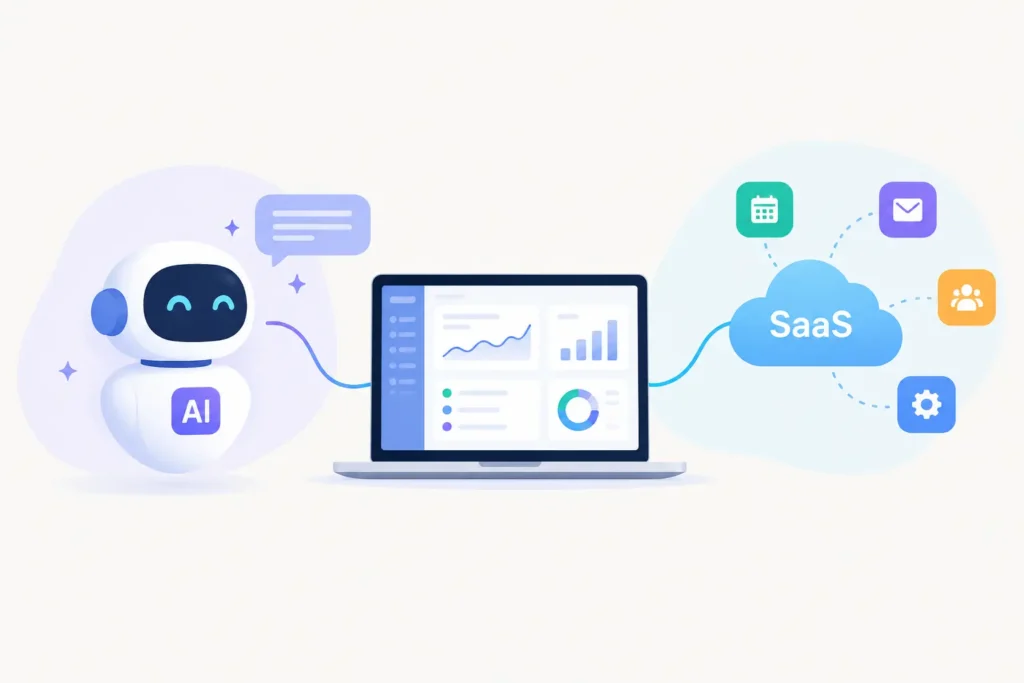
AI-powered SaaS combines traditional software functionality with artificial intelligence. Instead of simply providing tools for users to operate manually, these platforms can analyze data, generate recommendations, automate workflows, and assist with decision-making.
For example, a traditional CRM helps businesses organize customer information and track sales activities. An AI-powered CRM can go further by identifying promising leads, summarizing customer conversations, predicting sales trends, and suggesting follow-up actions.
This shift makes software more intelligent, efficient, and useful for businesses of different sizes.
How AI Could Replace Some SaaS Tools
Although AI will not eliminate every SaaS product, it could disrupt certain software categories.
1. Simple Applications May Become Less Necessary
Many software products focus on a single, straightforward task, such as summarizing documents, generating basic reports, or rewriting text.
AI assistants can increasingly perform these tasks through simple prompts. Instead of subscribing to several separate tools, users may accomplish similar work within a single AI platform.
As a result, SaaS companies that offer limited functionality without meaningful differentiation could face greater competition.
2. Businesses May Need Fewer Separate Tools
Businesses often use multiple applications for writing, research, scheduling, reporting, and customer communication.
AI can connect workflows and automate tasks that previously required switching between platforms. This could reduce the need for some standalone applications, especially when their features can be replicated by a broader platform.
However, specialized tools may remain valuable when they offer deeper functionality, integrations, security, or industry-specific capabilities.
3. Traditional User Interfaces Could Change
Conventional SaaS software often requires users to navigate menus, dashboards, and settings to complete tasks.
AI assistants are introducing a different approach: users can describe what they want in natural language.
For instance, instead of manually creating a sales report, a user might ask an AI assistant to analyze monthly sales, identify underperforming products, and summarize the results.
This does not necessarily eliminate the underlying software. Instead, it changes how people interact with it.
How AI Can Make SaaS Software More Powerful
For many SaaS companies, AI represents an opportunity to improve existing products rather than replace them.
1. Automating Repetitive Work
AI can automate routine activities such as data entry, email categorization, meeting summaries, and follow-up reminders.
These capabilities allow employees to spend more time on strategic tasks instead of repetitive administrative work.
2. Delivering Better Customer Experiences
AI-powered customer support tools can answer common questions, recommend relevant resources, and help support teams prioritize requests.
When integrated with a company’s existing systems, AI can use relevant customer information to provide more contextual assistance, subject to appropriate privacy and access controls.
3. Improving Business Decisions
Traditional SaaS platforms store and organize business data. AI can help users interpret that information by identifying patterns, highlighting unusual activity, and generating forecasts.
For example, analytics software can help businesses understand customer behavior and identify potential sales opportunities. These predictions still require human judgment and reliable data.
4. Making Advanced Software More Accessible
AI can make sophisticated software easier to use for people without technical expertise.
Users may be able to create reports, configure workflows, or explore datasets through conversational instructions rather than learning every feature manually.
This can make existing SaaS products more accessible to small businesses and growing teams.
What Does the Future Hold for SaaS Companies?
The future of SaaS will likely involve a combination of AI automation, specialized software, and human oversight.
Successful SaaS companies will need to offer more than basic features that AI assistants can easily reproduce. They will need to provide reliable infrastructure, strong integrations, accurate data, security, compliance, and solutions tailored to specific business needs.
At the same time, companies that integrate AI thoughtfully may gain a competitive advantage by delivering greater value through their existing products.
Businesses choosing SaaS tools should therefore evaluate not only AI features but also usability, pricing, data protection, integration capabilities, and long-term reliability.
Conclusion
AI is more likely to reshape the SaaS industry than replace it completely. Basic software applications may face disruption, while established SaaS platforms can become more capable through intelligent automation, predictive analytics, and conversational interfaces.
For businesses, the goal should not simply be to replace every existing tool with AI. Instead, it should be to identify where AI can improve productivity, reduce unnecessary complexity, and deliver measurable results.
The SaaS companies that adapt to this shift will be better positioned to remain competitive. Ultimately, the future belongs to software that combines AI’s intelligence with the reliability, security, and specialized functionality businesses need.


